What Is Freemium? When a Free Tier Drives Growth and When It Becomes a Burden

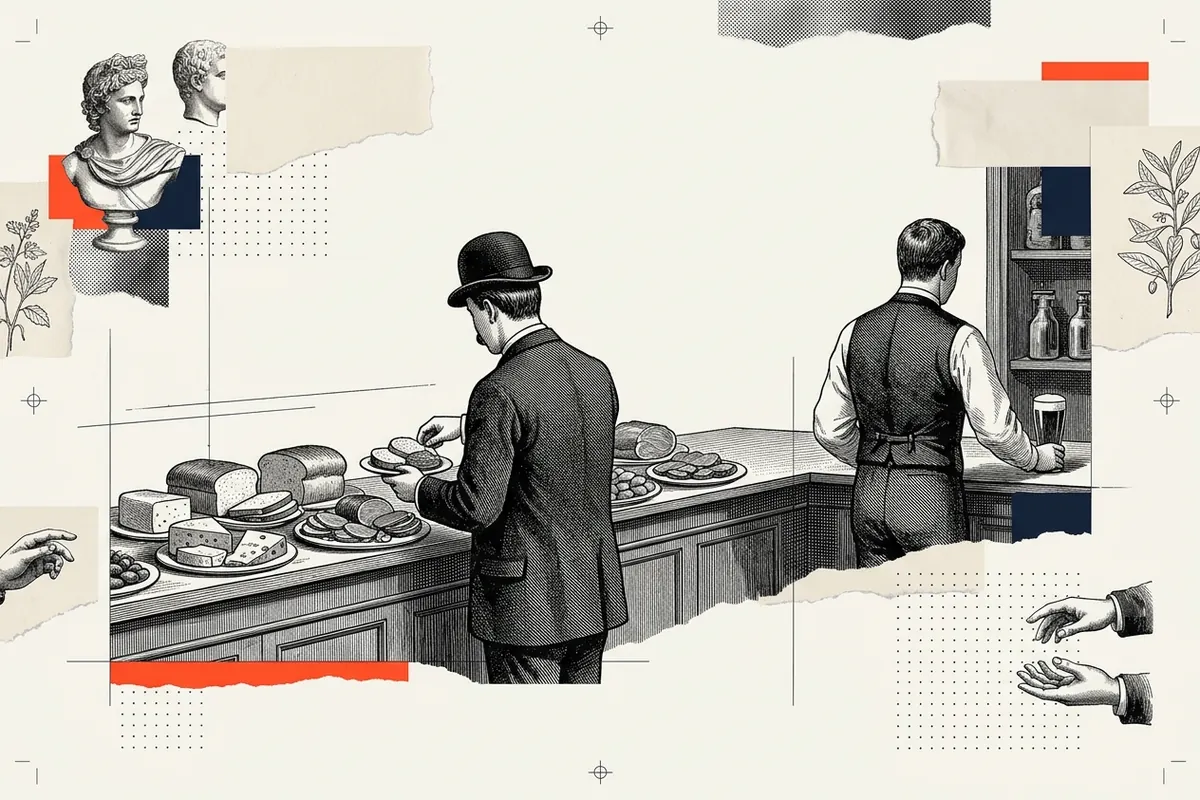
In one of his American essays, published in 1891, Rudyard Kipling describes a bar he walked into in San Francisco. The walls were hung with bad Salon pictures, and men with their hats pushed back on their heads were wolfing food at the counter. What he had stumbled on, in his words, was the institution of the "free lunch": you paid for a drink and got as much as you wanted to eat. A man could feed himself handsomely there for less than a rupee a day, he wrote, even if he were bankrupt.
The free lunch was a widespread custom in American bars; the phrase turns up often in American writing from about 1870 to the late 1920s. The one condition was to buy at least one drink. The food was often worth more than that drink; the saloon keeper was counting on customers not stopping at one glass and coming back at other times of day. According to Lender and Martin's Drinking in America, the food was usually well salted to make people thirsty.
There was another side to the sums. In 1872 the New York Times wrote about the "loafers and free-lunch men" who cleared the buffet without buying anything. The "free lunch fiend" was a recognised type, and burly men at the door guarded the buffet. In 1896 New York's Raines Law banned the free lunch; the following year the law was amended and the custom returned.
Plenty of software makes the same calculation today. The free tier is the bar's buffet. The real question is still the same: how many of the people at the buffet are buying a drink?
What is freemium?
Freemium is a model in which you give away a basic version of the product indefinitely and charge those who want more. The word joins "free" and "premium". Unlike a free trial, the free tier never runs out: a user can stay for years without paying.
Dropbox's IPO filing of February 2018 sums up the model in a sentence: anyone can sign up for free and upgrade to a paid plan for premium features. According to the same document, the company had more than 500 million registered users and over 11 million paying users. Roughly, two in every hundred registered users paid. In 2017 average revenue per paying user was USD 111.91.
When does a free tier drive growth, and when does it become a burden?
Someone has to pay for the free product
Failory's piece on Robinhood shows well where free comes from. Robinhood was one of the pioneers of commission-free share trading. According to the article, about 72.8% of its revenue comes from payments by the market makers that execute users' orders. The paid Robinhood Gold membership, at USD 5 a month, makes up less than 10% of total revenue.
The lesson is this: a free tier is not a gift but a financing decision. In the bar the drinks did that job, at Robinhood the order flow. If you cannot say in one sentence who covers the cost of your free users, you are paying for the buffet out of your own pocket.
The conversion rate is small, so build your sums around it
As in the Dropbox example, paying users are a small share of registered users. That is why freemium only works when the cost of each free user is very low and the total audience very large. Work it backwards: does what one paying user brings in cover the servers, support and infrastructure for the dozens of free users alongside them?
Track that rate together with churn. People who upgrade and leave a few months later make the conversion rate look better than it is. You can find how to measure churn in the piece on customer churn.
Draw the line just behind the value
The free tier should show why the product works, but not meet the whole need. A free tier that is too generous turns into a buffet where nobody buys a drink. One that is too stingy lets nobody through the door. The line is usually drawn at the point where users have got used to the product and want more: storage space, number of team members, access to past records.
Free users have a cost too
The men at the bar door were not there for nothing. Users who will never pay still open support tickets, use resources and create abuse. Putting reasonable usage limits on the free tier is not being stingy with the product; it keeps the buffet standing. When you build your price tiers, the principles in the piece on pricing will help too.
Premium and the pull of zero
The second half of the model's name comes from the Latin praemium. The word joins prae, "before", with emo, "to obtain", and carries the sense of "what one has got before or better than others". Its first meaning was profit taken from booty; later it became a reward. In English one of its meanings today is something offered at a reduced price as an inducement to buy something else. Freemium joins the two: what is free is there to open the way to the reward.
Kristina Shampanier, Nina Mazar and Dan Ariely measured that feeling in Marketing Science in 2007. In their experiments the price difference between two products was held constant, and only the cheaper one was priced either at a small amount or at zero. When the cheaper product was free, dramatically more people chose it and markedly fewer chose the more expensive one. According to the researchers, a zero price did not just lower the cost but also made the product's benefit seem larger; affect was the most likely explanation.
Here lies both the strength and the trap of freemium. A zero price draws people through the door, but the same feeling also holds them back from upgrading. For a user who has grown used to free, the first penny weighs more than all the pennies that follow.
Last word
One of the earliest known uses of the saying "there's no such thing as a free lunch" is the last line of Herman Fetzer's piece "Economics in Eight Words", published in The Cleveland Press on 4 May 1933:
"There is no such thing as free lunch."
Someone always pays for the free lunch. Who is paying for the buffet in your product, and will they still be buying drinks tomorrow?
If you want to know how to win paying customers again every month, the piece on the subscription model is worth a read.