What Is a Subscription Business Model? Being Chosen Again Every Month

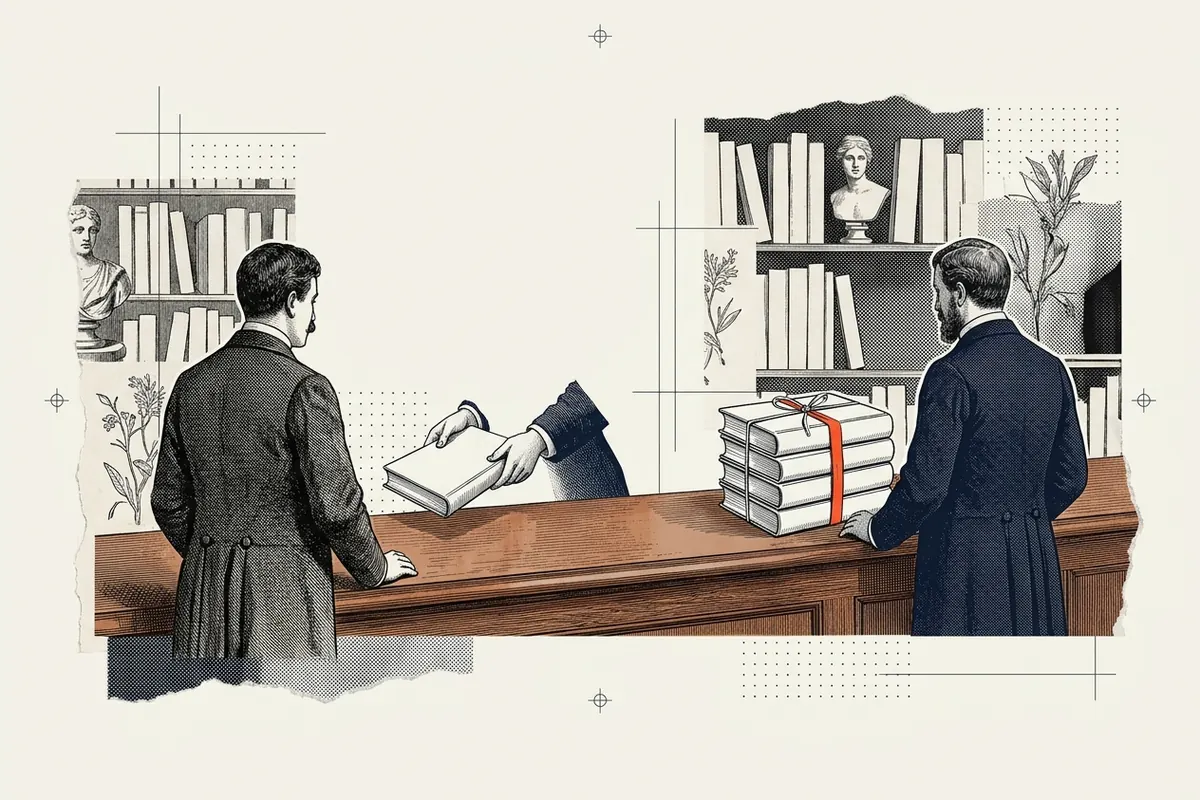
In 1842 Charles Edward Mudie, who ran a small bookshop in Bloomsbury, London, decided to stop selling books and start selling reading. The offer was simple: pay one guinea a year, take out a volume, bring it back when you have finished and take the next one. According to Wikipedia, other lending shops of the time were charging between four and ten guineas a year.
The offer drew its strength from the novel of the day. In Victorian England a new novel usually came out in three volumes and sold for a guinea and a half, or 31 shillings and sixpence. That was around half the weekly income of a modest middle-class household. Buying the novel was out of reach for most readers; the easiest way to read it ran through Mudie's counter.
Mudie solved one more annoyance. For readers who did not want to finish the first volume and then wait for someone to return the second, he offered four volumes at a time for two guineas a year. In 1852 the business moved to larger premises on New Oxford Street. Books went out across London by delivery van, to the provinces by rail and overseas in watertight tin boxes. In November 1859 Mudie bought 500 copies of Darwin's On the Origin of Species in one go. Darwin himself was a five-guinea subscriber.
The subscription grew so powerful that it shaped the novel itself. Three volumes meant three separate loans of the same book for the library. Three-volume novels were often sold to the libraries before they were even printed. In 1894 Mudie's and W. H. Smith sent out circulars announcing that they would no longer pay more than four shillings a volume. The three-decker, which had held its price for nearly seventy years, soon disappeared.
What is a subscription business model?
A subscription business model is one in which customers, instead of buying a product once, pay at regular intervals for access to it. Software, a coffee box, a gym, a newspaper: in each case what is sold is not a single object but an ongoing relationship. Mudie's customers did not own the books; they bought the assurance that there would be something new to read every week.
That is why a subscription is not sold once but again every period. Each month the customer quietly makes a decision: stay or cancel? How to measure that decision is the subject of the piece on customer churn. The question here is how to build the arrangement that keeps turning the answer into "stay".
How do you build a subscription?
Sell the problem solved, not the object
What Mudie sold for a guinea was not a book but a solution to being priced out of the novel. The value of a subscription comes from something the customer cannot easily get by buying things one at a time: price, continuity, the effort of choosing or regular delivery. Ask your product "why every month?". If there is no answer, the subscription is just a one-off sale paid in instalments, and the customer will notice on the first bill.
Tie each tier to a real frustration
Mudie's two-guinea tier was not a random "premium package"; it answered the impatience of the reader waiting for the second volume. A good tier removes a constraint the customer already feels: more use, less waiting, more people. Draw your tiers around where customers get stuck, not around your own cost sheet.
Invest in what happens after the sale
David Dewane, speaking to Starter Story, founded Mouse Book Club at the end of 2017. It printed phone-sized classics and posted them to members. In a 45-day Kickstarter campaign in spring 2018 the team reached its first 1,000 customers and $50,000. In a 2019 interview Dewane said they had mailed more than 40,000 books to over 60 countries.
His observation was this. Early backers were remarkably patient about a late parcel but hard to persuade to buy again; they liked what was new and then moved on to the next new thing. The ones who stayed were a smaller group who took to the company's purpose. So, he said, his real concern was how to add more value for members once the product was in their hands: meet-ups that brought readers together, spare books to pass on to friends. According to a note on Starter Story, the company closed in 2023. In a subscription the first sale opens the door; what earns the payment again each month is everything after the door.
Watch what could replace you
What slowly wore down Mudie's model was the publicly funded library, which offered a similar service for far less. Mudie's still lasted into the 1930s. A subscription's rival is not only another subscription. Any option that does the same job more cheaply, or in one go, is the other answer to the question your customer asks every month.
A boundary stone and a signature
The Turkish word for subscriber, abone, comes from the French abonné. The verb abonner meant "to set boundary stones" in Old French; at its root is borne, the stone that separates one field from another. Dictionaries also record an older use: tying a variable tax or levy to a fixed sum agreed in advance. In some French towns wine merchants could make exactly this kind of arrangement with the tax office instead of being inspected on every sale.
The English subscribe comes from the Latin subscribere, "to write underneath". The two words describe the same deal from two sides: drawing a boundary around an uncertain expense, and signing your name beneath it.
The marketing researchers Anja Lambrecht and Bernd Skiera gave this a name in a study published in the Journal of Marketing Research in 2006: the flat-rate bias. Many users chose a flat rate even when paying per use would have cost them less. Among the causes were a wish for insurance against a fluctuating bill and the unease of a taxi meter running with every use. What is more, the preference did not significantly increase churn. People sometimes pay as much for the boundary as for the service itself.

Last word
In George Gissing's New Grub Street, published in 1891, the novelist Edwin Reardon, who is trying to make a living from three-volume novels, explains why the libraries do not circulate novels in one volume:
"Profits would be less, I suppose. People would take the minimum subscription."
Mudie's two-guinea readers paid more because they did not want to wait for the second volume. At what moment does your customer feel that the minimum subscription is not enough?
If you are curious about another route to recurring revenue, What Is the Razor and Blades Model? Why the Real Money Is in the Add-On is worth a read.