What Is Content Marketing? Winning Readers Before You Sell

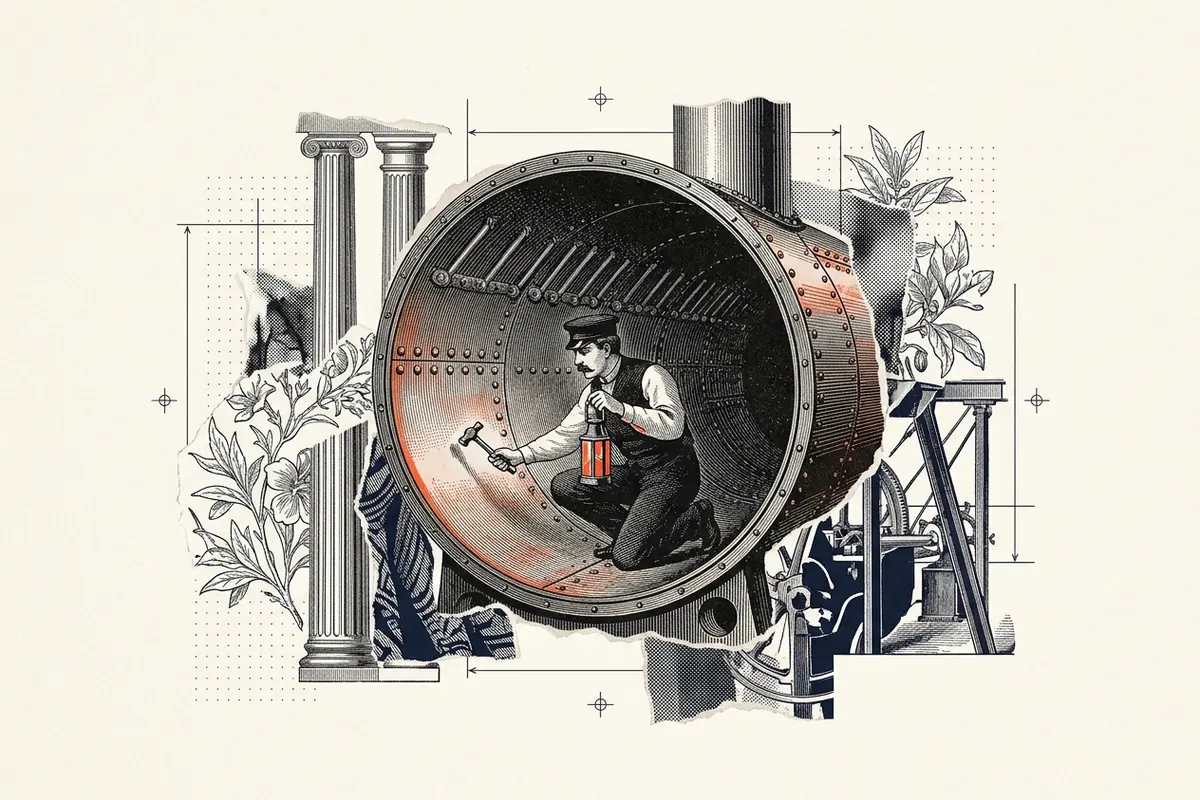
In the middle of the 19th century, when a steam boiler exploded in America, the blame often fell on electricity, an explosive gas or some unnamed mysterious force. Nor were explosions rare. According to Hartford Steam Boiler's own history, in the 1850s a boiler blew up almost every four days. On the night of 27 April 1865, the steamboat Sultana, licensed for 376 people, was carrying 2,127 on the Mississippi when her boilers exploded, and more than a thousand people died. The official inquiry pointed to poorly managed water levels in the boilers and a careless repair made a few days earlier.
In Hartford, a group of young men who had formed the Polytechnic Club in 1857 thought differently: a boiler bursts when it is put under more pressure than it can bear, and good materials, sound design and regular inspection prevent that. On 30 June 1866 the Hartford Steam Boiler Inspection and Insurance Company was founded on that idea. It saw itself first as a safety organisation and put insurance behind inspection.
In November 1867, in its second year, the company launched a small publication called The Locomotive. A note in the January 1880 issue states its purpose plainly: few people had access to books on steam engineering, and those that existed were so full of formulae as to be of little use to the ordinary reader. Every month the paper printed the defects its inspectors had found, statistics on boiler explosions and illustrated studies of individual explosions. The same note says demand, at home and abroad, had far exceeded expectations.
According to the August 1880 issue, it was distributed free every month. The reason took a single sentence: the interests of the company and its customers were identical, and nothing could be gained by concealment or misrepresentation. An insurer was earning trust by explaining to its customers how to keep their boilers from exploding. The policy came afterwards.
What is content marketing?
Content marketing means building an audience and trust by publishing regular, honest answers to the questions your readers actually ask, instead of describing your product. It can be a blog post, an email newsletter, a long guide or an answer that turns up in a search engine. Advertising stops the day you cut the budget. A good article keeps bringing readers for years.
The price is time. Content does not fill up like a campaign; it fills up like a storehouse. For the first months nobody notices; once the stock passes a certain threshold, readers start arriving without you doing anything.
Readers first, product second
As Starter Story tells it, Willie Jiang was a digital marketer who specialised in search engine optimisation. In 2018 he watched a presentation by Ramez Naam on solar energy and decided to enter the industry. But he did not start with a product. In March 2019 he bought a blog called SolarMetric, in July 2019 he bought the domain solarfeeds.com for about $6,000, and with full-time writers he began publishing articles about solar energy.
Around 18 months later, by about February 2021, SolarFeeds had reached 35,000 unique visitors a month. Only then did the product arrive: using an off-the-shelf WordPress theme, Jiang built a marketplace connecting solar product suppliers with installers in about a month and launched it in March 2021. Without any advertising, two or three buyer enquiries came in each day and suppliers signed up daily. Jiang's reasoning is simple: build the audience first, and even if your first product fails, your business does not end with it.
Where to start with content marketing
Map your reader and their path
Before choosing a channel, Jiang worked out who his buyer was and which steps they went through on the way to a purchase. An article written without knowing who is searching, with which question and at which stage, answers nobody.
Pick a single channel
Jiang's advice to early-stage startups is not to go into every channel at once. Choose the channel that works best for you and stay with it until its growth plateaus. For SolarFeeds that channel was search. Spreading yourself across bets such as video and viral content, he says, leaves every channel underfed.
Start with small experiments
Starter Story's founder, Pat Walls, describes the method that grew his own site as "minimum viable content". Rather than spending weeks on a single article, he publishes many short experiments at once, checks the results after 30 days, then scales what works and changes or drops what does not. According to Walls, once the team took the method seriously, search traffic grew fourfold in six months.
Answer, don't sell
The defect lists The Locomotive printed each month were not advertisements; they were records the reader could use. Let your articles describe your reader's problem, not your product. Explain the problem well and your product will find its place as the natural answer to it.
Be regular and patient
SolarFeeds reached thirty-five thousand readers in a year and a half. Choose a rhythm you can sustain, such as one article a week, and keep to it. Trust comes not from a single brilliant piece but from answering the same question honestly for months.

The shop and the magazine come from the same storehouse
Calling a periodical a magazine in English began as a metaphor. When Edward Cave launched The Gentleman's Magazine in London in January 1731, he became the first to use the word for a periodical. Until then a magazine meant "a storehouse, a depot". The word came through French magasin and Italian magazzino from Arabic maχāzin, the plural of maχzan, "storeroom, storehouse". Its root, χ-z-n, means "to store, to lay up".
Turkish mağaza, "shop", travelled the same road, entering the language through Venetian magazén, "warehouse, store for merchandise". One became the place where things are sold, the other the store of knowledge a reader keeps coming back to. Content marketing brings the two back under one roof: first the storehouse fills, then the shop opens its doors.
A final word
In "Of Studies", in the 1625 edition of his Essays, Francis Bacon weighs reading, conversation and writing in a single sentence:
"Reading maketh a full man; conference a ready man; and writing an exact man."
Reading fills you, conversation readies you, and writing makes you precise.
Writing for their readers every month, the engineers in Hartford sharpened their own knowledge too. What question is your reader looking for an answer to today, and could you put it into writing this week?
To see how to turn your first readers into customers, Finding Your First Customers: The Road from Zero to Your First Sale is worth a read.