Finding Customers with Cold Email: How to Sell Without Sending Spam

At the end of May 1864, a telegram arrived at the doors of several Members of Parliament in London. Delivered by the London District Telegraph, it carried a single piece of news: Messrs. Gabriel, dentists, of 27 Harley Street, would be in professional attendance from 10 till 5 until October.
Nobody had asked for this. One recipient, signing himself simply "M.P.", wrote to The Times. In a letter dated 30 May, he said he had never had any dealings with the Gabriels and asked by what right they disturbed him with a telegram that was evidently nothing more than an advertisement. All he wanted was a word from the paper to put a stop to this "intolerable nuisance".
Today that telegram is remembered as the first recorded mass unsolicited commercial telegram. The great-grandparent of spam, in other words. More than 160 years have passed, and the recipient's irritation has not changed at all.
Does cold email still work?
A cold email is the first email you send to someone who does not know you. Most read like the Gabriels' telegram: a stranger announcing something nobody asked about. Which is why most go unanswered.
Even so, for a small startup it remains one of the fastest and most measurable channels there is. As Neil Cocker tells it on Starter Story, his team was growing RampTshirts, which sells t-shirts and branded merchandise, without outside investment. Advertising was expensive; search and content were slow. They chose cold email, on one condition: it had to look genuinely relevant to the recipient, not like spam.
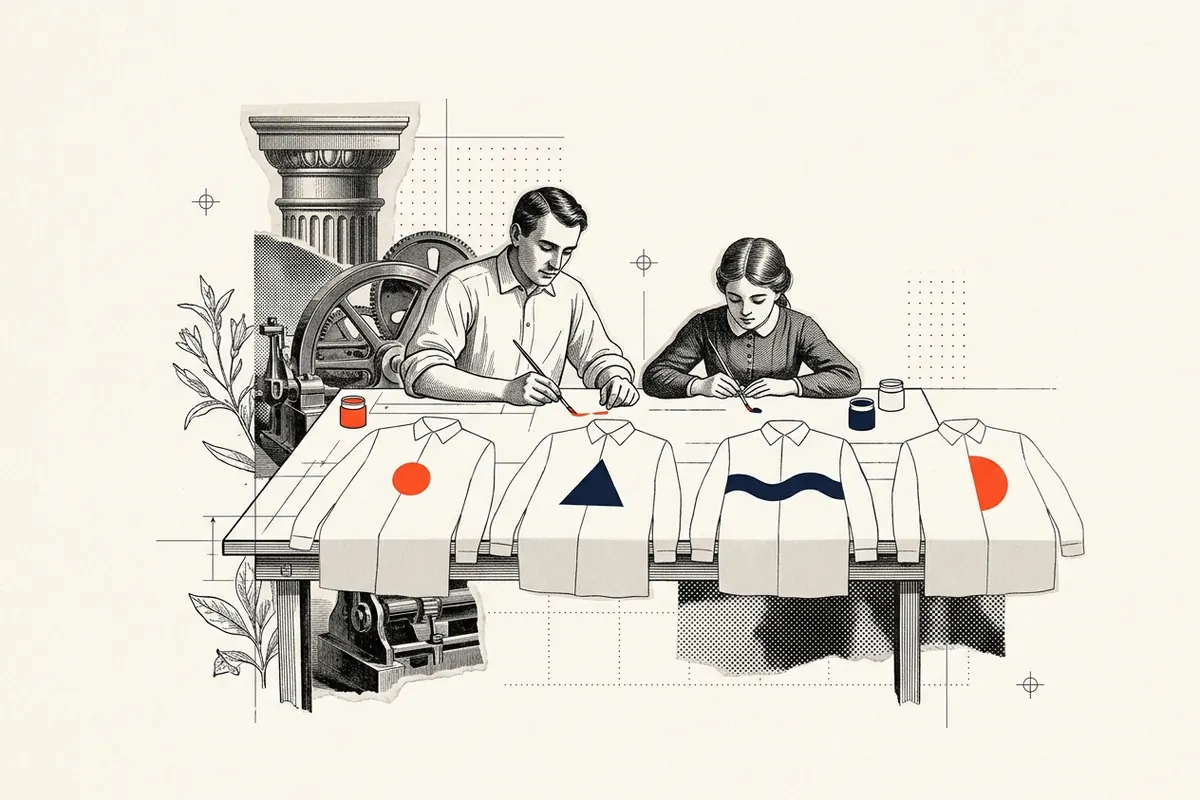
The idea they landed on was simple. They would send each company a picture of a t-shirt printed with its own logo, with the sales email alongside it.
Start by hand, and start small
The first test was barely technical at all. Cocker and his marketing assistant, Romina, spent about four hours researching target companies, finding email addresses and placing each logo, one by one, onto a photo of a plain white t-shirt in an image editor.
They wrote to 50 people. Half the emails were opened, 6 people replied positively, and no sales came in. That was not a failure; it was cheap proof that the idea made people stop.
In your first round, do not bother building tools either. Thirty or fifty emails written by hand will teach you which sentence earns a reply faster than any software.
Show recipients their own name
What got RampTshirts' emails opened was recipients seeing their own logo on screen. The message no longer said "we sell t-shirts"; it said "this is what your t-shirt looks like".
Personalisation is more than filling in a name field. A few rules help:
- Write to a real person: Once the team moved to an automated system, it filtered generic addresses such as info@, support@ and hello@ out of the list.
- Show something from their world: Their logo, their product, a piece of work they recently shared. Cocker suggests a consultancy could try the same approach with a satellite image of the prospect's office.
- Make replying easy: A question that can be answered in one sentence earns more responses than a long pitch.
Think of email as a funnel
The first lesson Cocker drew was that email is a funnel, like any other sales process. Each step builds on the one before:
- Land in the inbox: An email that goes to the spam folder is never read, however good its subject.
- Get opened: This is where the subject line lives. When the team switched to "I'm wearing a your company t-shirt!", some campaigns passed a 75% open rate.
- Get read: The image tells them, in the first second, why they should read on.
- Get clicked: The copy and the call to action point to a single next step.
If something is stuck, look for the problem at that step only. An email that is opened but gets no reply does not have a subject line problem.
Prove it before you scale it
In the second test, the team used a few off-the-shelf tools to find 250 addresses and produce 250 t-shirt mock-ups. The open rate was good again, replies went up and the first sale arrived. But for roughly 10 hours of work, the return looked thin.
Only at this point did the development team get involved. Finding addresses, pulling logos and generating images were all automated. Cocker's own photo replaced the stock model, which made the message more convincing. In later campaigns the average open rate stayed above 50%, and one well-targeted campaign reached a 25% click-through rate. The money spent on subscriptions and licences to prove the approach came to less than 50 pounds.
The order matters: by hand first, then semi-automated, and only then fully automated. Automating an unproven idea is nothing more than sending the Gabriels' telegram to more people, faster.
Hearing your name in a crowd
Psychologists call this the cocktail party effect. In a crowded room you focus on one conversation and the other voices turn into a hum. But if someone behind you says your name, you turn your head. Colin Cherry defined the problem in 1953.
In 1959 Neville Moray played participants one message to follow in one ear and another to ignore in the other ear, and slipped their names into the ignored message. As Conway, Cowan and Bunting reported in 2001, only 33% noticed their own name. When Wood and Cowan repeated the experiment in 1995, the figure was 34.6%.
So personalisation is not magic; it is a door. Recipients may turn their heads when they see their name, but the rest of the email decides whether they come in.
The rarest generosity
On 13 April 1942, Simone Weil wrote to the poet Joë Bousquet, confined to his bed by a grave war wound, to thank him for reading her pages so carefully. The letter contains this sentence:
"L'attention est la forme la plus rare et la plus pure de la générosité."
Attention is the rarest and purest form of generosity.
A good cold email gives attention before it asks for any. The Gabriels' telegram never looked at its recipients; RampTshirts' email began by looking at the recipient's logo. Does your next email pay its reader more attention than you are asking them to pay you?
If you want to see the other routes to a first sale before you turn to cold email, Finding Your First Customers: The Road from Zero to Your First Sale is worth a read.