How to Market a Taboo Product: Selling What Nobody Wants to Talk About

In the summer of 1912, at an exposition in Atlantic City, the woman staffing one stand went for days without selling a single bottle. The bottles held Odorono: a liquid that a Cincinnati surgeon had developed to keep his hands from sweating during operations. His daughter, Edna Murphey, had tried it under her arms, found that it worked, and had spent two years trying to sell it.
In the end the demonstrator wired Murphey asking for some cold cream to cover expenses. According to Smithsonian magazine, drawing on the company's records, the heat saved the day. The exposition ran all summer, and as visitors wilted, more of them drifted over to the stand. After that 1912 exposition, Murphey had customers across the country and $30,000 in sales to spend on promotion.
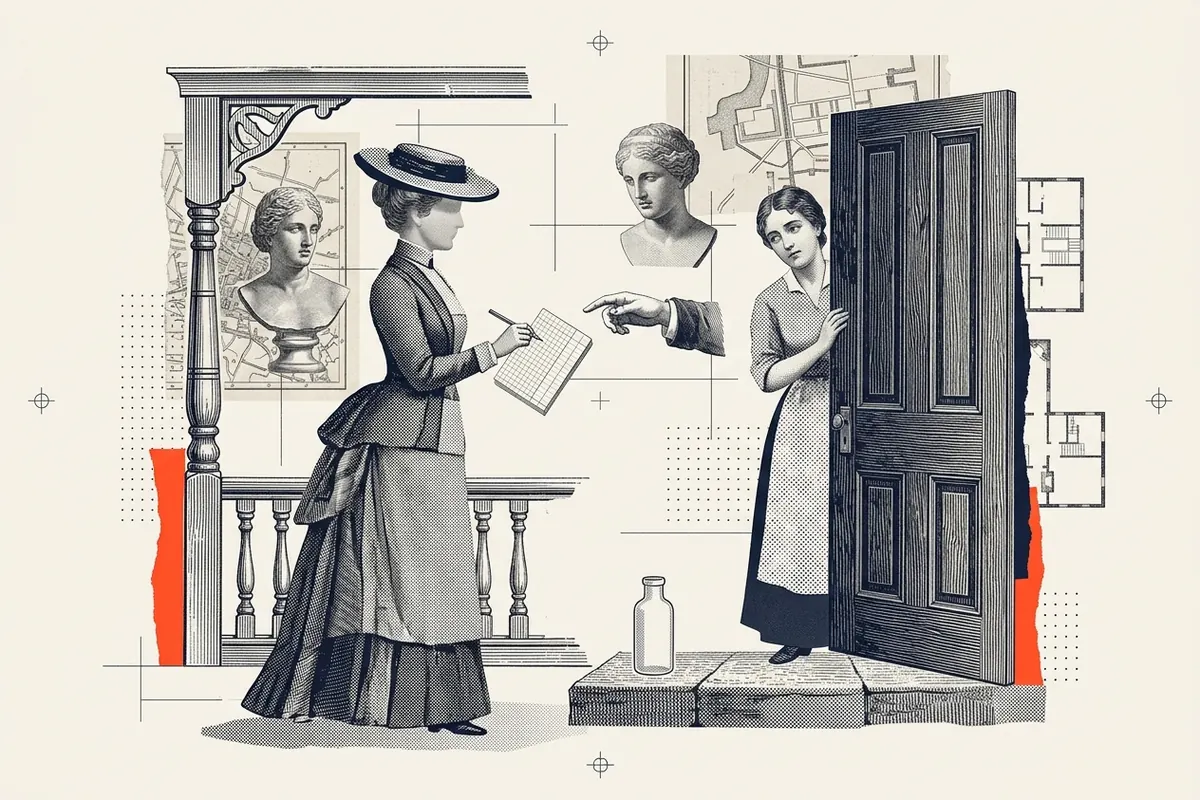
The real difficulty came next. In the words of advertising historian Juliann Sivulka, society was still very much Victorian, and nobody talked openly about perspiration. Murphey worked with James Young, a copywriter at the advertising firm J. Walter Thompson. Sales grew for a while, then stalled. In 1919 a door-to-door survey painted a strange picture: every woman knew Odorono, about a third used it, and two thirds felt they had no need for it.
That same year Young placed an advertisement in the Ladies' Home Journal. Beneath the headline ran the line: "A frank discussion of a subject too often avoided." According to Sivulka, some 200 readers were so offended that they cancelled their subscriptions. In his memoir, Young recalled that some women in his social circle stopped speaking to him. Yet according to the J. Walter Thompson archives, Odorono's sales rose 112% to $417,000 the following year, in 1920.
Silence is a competitor too
Selling perfume or fast cars is relatively easy: beautiful people, beautiful clothes, beautiful scenes. As Ralph Jones tells it in The Hustle, when it comes to products people are ashamed to buy, the job gets uglier and more complicated. For haemorrhoid cream, incontinence pads or sanitary pads, the biggest rival is often not another brand but silence.
Odorono's story shows both faces of that silence. Break it and the market grows. But the way you break it can open a fresh wound. The steps below take both into account.
First, find out why people stay silent
Young's survey showed that the problem was not a lack of awareness. Everyone knew the product. The obstacle was that people did not accept the need.
If you sell a taboo product, your first job is to tell apart two situations: people do not know you, or people do not see the problem as theirs. Each needs a different remedy. The first calls for visibility, the second for permission to talk about it.
Use humour, but never laugh at the problem
According to Jones, copywriter Prabhu Wignarajah and his team at AMV BBDO, one of the world's largest advertising firms, chose humour in 2015 when they made the first television campaign for Tena Men, an incontinence pad for men. Their hero, Stirling Gravitas, was a man ludicrously in control of every part of his life. He juggled chainsaws, he told a lion to stay, and the lion stayed.
The team had one rule: the joke was never at the expense of the condition itself. Ten years later, in a 2025 advertisement, the tone changed; a middle-aged man looked into the camera and talked plainly about his urine leakage. Humour had pushed the door ajar, and once it was open, plain speaking became possible.
Listen to your customers' own words
When the communications company The Gate took on Anusol, a haemorrhoid cream in the UK, it began by looking at the competition. In the words of strategy director Bruno Carramaschi, the whole category treated the condition as a dirty secret. Then the team read customer reviews on Amazon and found them very funny.
That tone was closer to the truth. The advertisement was made in the same spirit, with an apricot, a pear, a cactus and a balloon knot standing in for the bottom. However your customers describe their problem among themselves, your voice should sound just as close to them.
Go out on the high street
The Gate did not hide the campaign among targeted digital ads; it made the brand's first ever television advertisement in the UK. In testing, some viewers were uncomfortable, and some said it would be awkward to air around dinnertime. The team read that as a sign of exactly what it should do. As Carramaschi puts it, if you really want to break a taboo, you have to put it on mainstream channels.
Show what is normal as normal
Until 2017, the blood in sanitary pad advertising was blue. Red, people argued, would upset viewers. Bodyform's Blood Normal campaign, led by Nadja Lossgott and Nick Hulley at AMV BBDO, did something simple: it showed the blood as red.
Lossgott's question was this: what if we just treat it as normal and show it the way it is, without making a big deal of it? According to Margaux Revol, the campaign's strategist, the approach later became a recipe for many other brands.
Do not manufacture the shame yourself
Odorono's success has a shadow. Young presented sweating as a flaw nobody would mention to your face but everyone would gossip about behind your back. Sales grew, but the product grew partly on the anxiety it created.
According to research cited by The Hustle, disgust can work in some advertising; the anti-smoking ads that provoked the most disgust were found to be the most effective. Still, Revol's warning is clear: when people are deeply ashamed, confronting the issue head-on only reminds them of their shame. That is when you need a lateral, creative route.
- Reduce the shame: like Tena Men and Blood Normal, show the problem as an ordinary part of being human.
- Do not sell fear: a sale won by making customers feel flawed leaves anxiety behind instead of trust.
- Make the moment of purchase easy: finding the product, putting it in the basket and paying are part of your communication too.
The word taboo came from a dinner
The word "taboo" entered English in 1777, with the explorer James Cook's visit to Tonga. Cook invited some Tongan nobles to dinner aboard his ship. Not one of them would sit down or eat a bite. When he expressed his surprise, they said they were all "taboo". According to Cook's note, the word had a very comprehensive meaning, but in general signified that a thing was forbidden.
Its root is the Tongan tapu, which in Polynesian languages covers both what is forbidden and what is held untouchable. Embarrassing products sit in a similar space. Nobody has banned them, yet nobody says their names out loud.
Where that silence is felt most has been studied too. According to two field studies by Darren Dahl, Rajesh Manchanda and Jennifer Argo, published in the Journal of Consumer Research in 2001, what triggers embarrassment when buying an embarrassing product is the sense that others are present during selection and checkout. That presence can be real or imagined. The more familiar the purchase becomes, the less embarrassment people feel. So the shelf, the till and the basket are your business as much as the advertising.
Nothing human
In The Self-Tormentor, written by the Roman playwright Terence in 163 BC, old Chremes is accused of meddling in his neighbour's affairs. When the neighbour asks whether he has so much free time that he can busy himself with matters that do not concern him, he replies:
"Homo sum: humani nil a me alienum puto."
I am human; nothing human is alien to me.
Good campaigns for taboo products say that sentence again: sweat, blood and the ageing body are all part of being human. Which of your customers' silences does your product touch, and are you easing that silence or deepening it?
If you want to ask your customers the right questions to understand why they stay silent, How to Run a Customer Interview is worth a read.